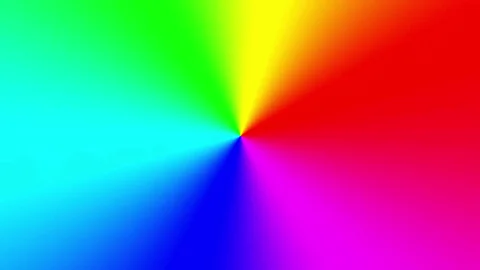
RGB stands for Red, Green, and Blue. It’s an additive color model, meaning that colors are created by adding together different intensities of red, green, and blue light.
Here’s a breakdown of what that means and why it’s important, especially in the context of printing:
How RGB Works
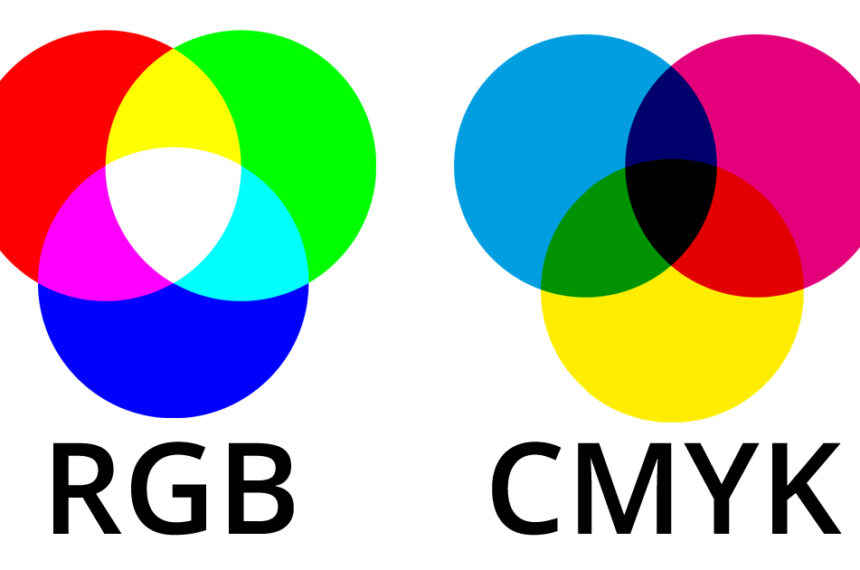
- Additive Process: Imagine shining three spotlights – one red, one green, and one blue – onto a black surface.
- Where only the red light shines, you see red.
- Where red and green light overlap, you see yellow.
- Where green and blue light overlap, you see cyan.
- Where blue and red light overlap, you see magenta.
- Where all three colors (red, green, and blue) overlap at full intensity, you get white light.
- When there is no light (zero intensity for all three), you see black.
- Light-Emitting Devices: This additive principle is how screens work. Every pixel on your computer monitor, TV, smartphone, or tablet is made up of tiny red, green, and blue light-emitting elements. By varying the intensity of these three lights, these devices can produce millions of different colors.
- Numeric Representation: In digital design, RGB colors are typically represented by three numbers, each ranging from 0 to 255.
- (255, 0, 0) represents pure red.
- (0, 255, 0) represents pure green.
- (0, 0, 255) represents pure blue.
- (0, 0, 0) represents black (no light).
- (255, 255, 255) represents white (all lights at full intensity).
Where RGB is Used
RGB is the standard color model for anything that is displayed on a screen or emits light:
- Computer Monitors & TVs
- Smartphones & Tablets
- Digital Cameras
- Scanners
- Web Design & Digital Graphics
- Video Production
- LED Displays & Lighting
RGB vs. CMYK: The Crucial Difference for Printing
This is where the distinction becomes critical for anyone involved in printing:
- RGB (Additive) for Screens: Uses light, combines to make white. Has a very wide “gamut” (range) of vibrant colors.
- CMYK (Subtractive) for Print: Uses ink, combines to make black. Colors are created by inks absorbing certain wavelengths of light and reflecting others.
Why this matters for printing:
- Color Gamut Discrepancy: RGB has a much larger color gamut than CMYK. This means there are many bright, vibrant colors you can see on your screen (in RGB) that simply cannot be reproduced accurately with standard CMYK inks.
- Color Shift: If you design something in RGB and then send it directly to a commercial printer without converting it to CMYK, you will almost certainly experience color shift. The colors in your printed piece will likely appear duller, less vibrant, and potentially inaccurate compared to what you saw on your screen. Bright blues might become muted, vibrant greens might appear flatter, and oranges could lose their pop.
- Printer Requirements: Most commercial printers (offset and many digital presses) are calibrated to print using CMYK inks. While some advanced digital printers can handle RGB files, they typically perform an automatic conversion to CMYK, which can still lead to unexpected results.
Best Practice for Printing:
- Always design in CMYK if your final output is intended for print.
- If you’ve started a design in RGB, convert it to CMYK before sending it to your printer. Be prepared to make some color adjustments after conversion, as the colors may shift.
- Communicate with your printer. They can advise on optimal color profiles and provide proofs (especially hard proofs) to ensure color accuracy.
- For critical brand colors, consider using Pantone (spot colors) in conjunction with CMYK, as Pantone provides a standardized, pre-mixed ink that ensures consistent color reproduction.
In essence, RGB is how we experience color in the digital, light-emitting world. But for anything you hold in your hands – a brochure, a business card, a poster – CMYK is the language printers speak. Understanding this fundamental difference is key to achieving consistent and high-quality printed results.
The most trusted and quality printing company, with excellent customer service. Best Quality Printing in Dubai
#EWANPRINTING
WhatsApp/Call us:
Arabic: 055 5771552
Arabic & English: 056 5071752 – (Send Query) https://wa.me/message/ZCPEMGR67ZD6G1
English | Urdu | Hindi: 050 508 6855
For latest offers
Email: printingewan@gmail.com
Location: Shop 26 and 28, Al Nasiriya Building, 247 Damascus Street, Al Qusais Industrial Area 1, Dubai, UAE
Leave a Reply