
Decoding Print Terminology: Your Essential Glossary for Flawless Printing
The world of printing, while fascinating, can often feel like it’s speaking its own language. From “bleed” to “CMYK,” “gsm” to “offset,” a clear understanding of key terminology is crucial for anyone looking to get their designs accurately and beautifully translated onto paper. Whether you’re a designer, a marketer, or a business owner in Dubai navigating a printing project, this essential glossary will help you speak the language of print with confidence.
The Essentials: Laying the Groundwork
- Bleed: This is ink that extends beyond the edge of the finished (trimmed) size of your print project. A standard bleed is usually 3mm (0.125 inches) on each side. It’s essential to include bleed in your design to prevent unsightly white edges if the paper shifts slightly during the cutting process.
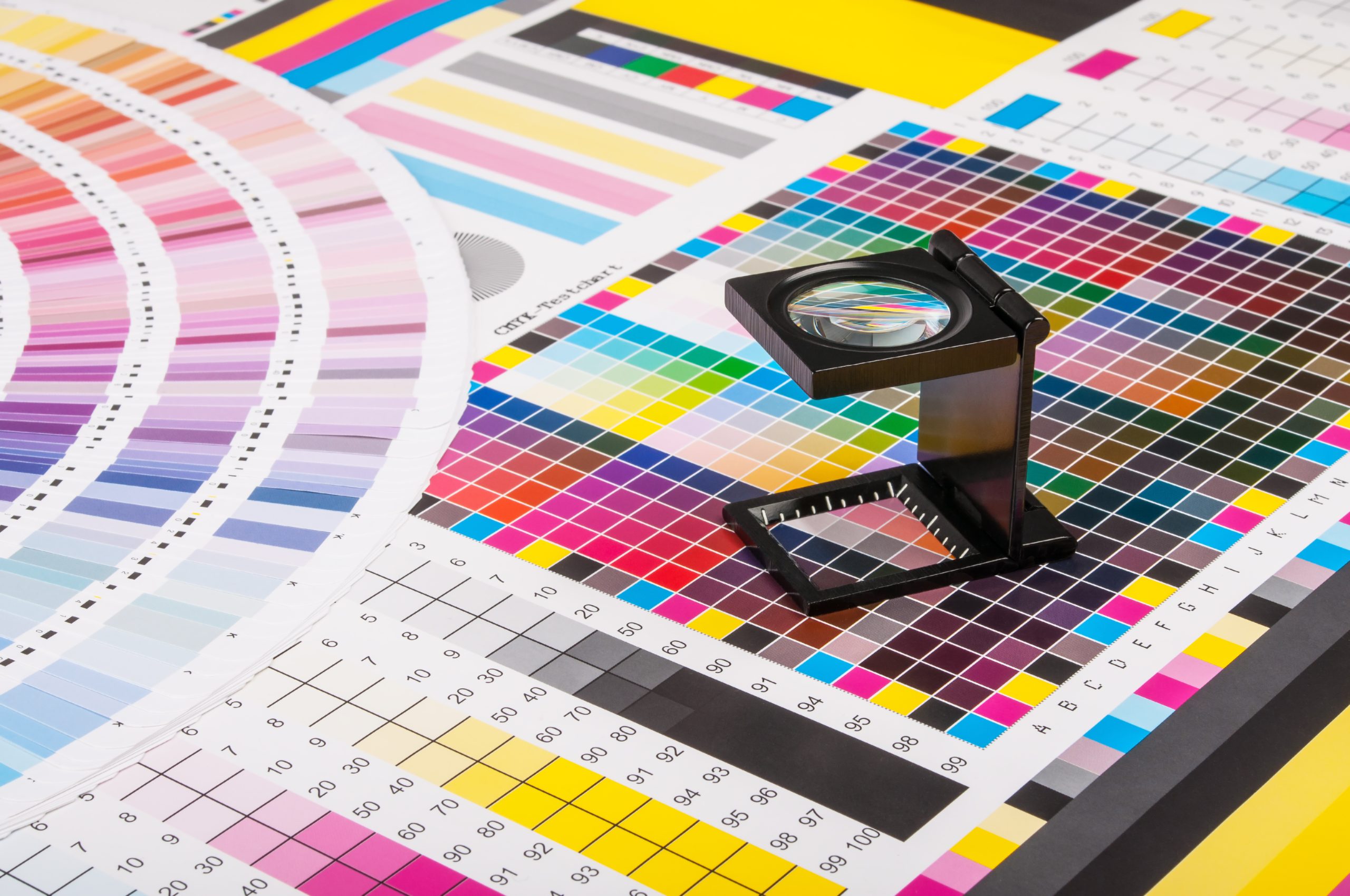
- CMYK: This acronym stands for Cyan, Magenta, Yellow, and Key (Black). These are the four process colors used in most commercial printing. Unlike RGB (Red, Green, Blue) which are additive colors for screens, CMYK colors are subtractive, meaning they absorb light. Understanding this difference is vital to avoid color shifts between your screen and your printed output.
- RGB: Red, Green, Blue. These are the additive primary colors of light, used by digital screens (monitors, TVs, phones). Designs created in RGB mode need to be converted to CMYK for print, which can sometimes lead to slight color variations.
- Resolution (DPI/PPI):
- DPI (Dots Per Inch): Refers to the number of individual dots of ink a printer can place within one linear inch. Higher DPI generally means sharper, more detailed prints. For high-quality commercial printing, 300 DPI is typically the standard for images.
- PPI (Pixels Per Inch): Refers to the number of pixels within one linear inch of a digital image. This relates to screen display.
- Proof: A preliminary version of your print project, provided for review and approval before final production. Proofs can be digital (PDFs) or hard copy (physical prints).
- Trim Size / Finished Size: The final dimensions of your printed piece after it has been cut. Always design with your desired trim size in mind, and extend your artwork into the bleed area.
Paper Talk: Understanding Your Substrate
- GSM (Grams per Square Meter): This measures the weight and thickness of paper. A higher GSM indicates a heavier, often more substantial paper. For example, 80-100 GSM is typical for copier paper, while 300-400 GSM is common for business cards or heavy covers.
- Paper Stock / Substrate: The specific type of paper or material being printed on. This can include various finishes and weights.
- Coated Paper: Paper with a thin layer (often clay-based) applied to its surface to improve print quality, enhance ink holdout, and create different finishes.
- Gloss Coated: Has a shiny, reflective surface, making colors appear vibrant.
- Matte Coated: Has a smooth, non-shiny finish that reduces glare and offers a more subdued look.
- Silk/Satin Coated: A finish between gloss and matte, offering a subtle sheen.
- Uncoated Paper: Paper without any surface coating. It has a more porous, natural feel, and inks tend to be absorbed, resulting in a softer, more muted appearance.
- Finish: Refers to the surface texture and appearance of the paper (e.g., gloss, matte, silk, linen, smooth, vellum).
Printing Processes and Techniques
- Offset Printing: A widely used commercial printing technique where an inked image is transferred (or “offset”) from a plate to a rubber blanket, then to the printing surface. Ideal for large print runs, offering high quality and cost-effectiveness per unit.
- Digital Printing: A method that prints directly from a digital file, without the need for plates. Perfect for short runs, variable data printing, and quick turnarounds.
- Screen Printing: A stencil-based printing method where ink is pushed through a mesh screen onto a substrate. Known for vibrant colors, durability, and versatility on various materials like fabric.
- Spot Color (Pantone): A pre-mixed, specific ink color, often from the Pantone Matching System (PMS), used in addition to or instead of CMYK. Spot colors ensure consistent brand color reproduction across different print jobs and materials, crucial for corporate branding.
- Varnish / Coating: A clear liquid applied over printed areas for protection, to enhance appearance (e.g., gloss, matte, satin), or to create specific effects.
- UV Coating: A liquid coating that is cured (hardened) by ultraviolet light, creating a very high-gloss and durable finish.
- Aqueous Coating: A water-based, fast-drying coating that provides protection and can have gloss, matte, or satin finishes.
- Lamination: A thin, protective plastic film applied to the surface of a printed piece for durability, water resistance, and to enhance appearance (e.g., matte, gloss, soft-touch lamination).
Finishing Touches: Beyond the Print
- Die-Cutting: The process of cutting paper or other materials into custom shapes using a sharp steel rule die. Used for unique packaging, tags, or brochures.
- Scoring: Creating a crease in paper to facilitate a clean, straight fold without cracking the paper fibers.
- Perforating: Creating a series of small holes in paper to allow for easy tearing, often seen on tickets or tear-off forms.
- Binding: The method used to secure pages together in a book, booklet, or catalog (e.g., perfect binding, saddle stitching, spiral binding, wire-o binding).
- Saddle Stitching: Binding method where folded sheets are stapled through the fold line, ideal for booklets with a low page count.
- Perfect Binding: Pages are glued together at the spine with a flexible adhesive, and a cover is wrapped around them, common for paperback books.
- Embossing / Debossing:
- Embossing: Creating a raised image or text on paper by pressing a die into the material from underneath.
- Debossing: Creating an indented image or text on paper by pressing a die into the material from above.
- Foil Stamping: Applying a metallic or pigmented foil to a surface using heat and pressure to create a shimmering, reflective effect.
By familiarizing yourself with these key terms, you’ll be better equipped to communicate your vision to your printing partner, ensure your files are prepared correctly, and ultimately achieve the high-quality printed materials you desire for your projects here in Dubai and beyond. Don’t hesitate to ask your printer for clarification – a good print professional will always be happy to guide you through the process.
The most trusted and quality printing company, with excellent customer service. Best Quality Printing in Dubai
#EWANPRINTING
WhatsApp/Call us:
Arabic: 055 5771552
Arabic & English: 056 5071752 – (Send Query) https://wa.me/message/ZCPEMGR67ZD6G1
English | Urdu | Hindi: 050 508 6855
For latest offers
Email: printingewan@gmail.com
Location: Shop 26 and 28, Al Nasiriya Building, 247 Damascus Street, Al Qusais Industrial Area 1, Dubai, UAE
Leave a Reply