
In the high-stakes world of printing, where every impression contributes to a brand’s image and a customer’s satisfaction, quality control (QC) isn’t just a step in the process – it’s the bedrock of success.1 From the smallest business card to the largest billboard, ensuring consistent, accurate, and flawless output is paramount.
Why Quality Control is Non-Negotiable
The importance of robust QC in printing cannot be overstated. It directly impacts:
- Brand Integrity: Printed materials are often the first physical touchpoint a customer has with a brand.2 Substandard quality can reflect negatively, eroding trust and professionalism.3 Consistent, high-quality prints reinforce brand identity and convey attention to detail.4
- Customer Satisfaction and Trust: Delivering on promises is key. When clients consistently receive prints that meet their expectations, it builds strong relationships, encourages repeat business, and generates positive word-of-mouth.5
- Cost Efficiency: Poor quality leads to costly reprints, wasted materials (paper, ink), increased energy consumption, and delays. Effective QC catches issues early, minimizing waste and streamlining production.6
- Competitive Advantage: In a crowded market, superior print quality can differentiate a business, attracting and retaining clientele who value excellence.7
- Regulatory Compliance: For certain industries, printed materials must adhere to specific standards and regulations (e.g., packaging for food or pharmaceuticals).8 QC ensures these requirements are met, preventing legal issues.9
The Stages of Quality Control in Printing
Quality control is a continuous process, spanning from the initial design phase to the final delivery.10
- Pre-Press Quality Control (The Foundation)This is arguably the most critical stage, as issues caught here are far less expensive to fix than on press.
- File Preparation & Preflight: Rigorous checks of digital files are performed to ensure they are print-ready.11 This includes:
- Resolution and Image Quality: Ensuring images are at least 300 DPI for sharp, non-pixelated prints.12
- Color Mode (CMYK vs. RGB): Verifying that files are in CMYK (cyan, magenta, yellow, black) for print, not RGB (red, green, blue) used for screens, to prevent color shifts.13
- Font Embedding/Outlining: Confirming all fonts are embedded or converted to outlines to avoid font substitution issues.
- Bleed and Margins: Checking for sufficient bleed (artwork extending beyond the trim line) to prevent unwanted white edges after cutting, and ensuring critical text/graphics are within safe margins.14
- Spelling and Grammar: A final proofread to catch any typos.15
- Resolution and Image Quality: Ensuring images are at least 300 DPI for sharp, non-pixelated prints.12
- Proofing: Providing the client with a representation of the final print.16 This can be:
- Digital Proofs: Soft proofs (PDFs) for quick review of layout, text, and general color.17
- Hard Proofs: Physical prints (often from a calibrated inkjet printer) that offer a more accurate color representation.18
- Press Proofs (Wet Proofs): Short runs on the actual printing press using the intended paper and inks, offering the most accurate preview of the final product, especially crucial for color-critical jobs.
- Digital Proofs: Soft proofs (PDFs) for quick review of layout, text, and general color.17
- File Preparation & Preflight: Rigorous checks of digital files are performed to ensure they are print-ready.11 This includes:
- During-Press Quality Control (Real-Time Monitoring)Once a job hits the press, constant vigilance is essential to maintain consistency throughout the run.
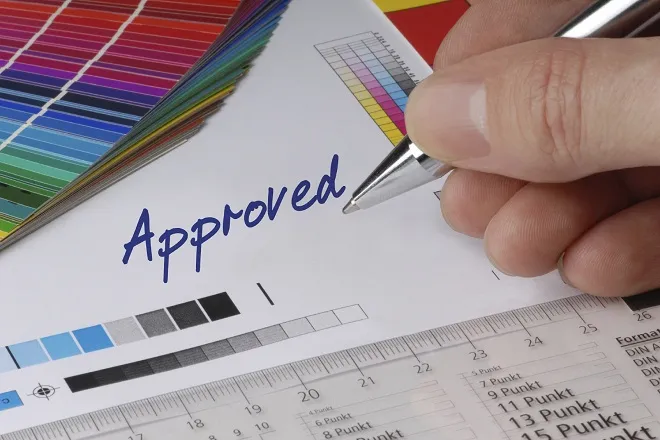
- Press Checks: Initial prints are meticulously inspected against approved proofs.19
- Color Accuracy and Consistency: Using tools like densitometers and spectrophotometers to measure ink density, color saturation, and hue.20 Densitometers measure the amount of light absorbed by ink, providing quantitative data on solid ink density and dot gain (the spread of ink dots on paper).21 Spectrophotometers offer a more comprehensive spectral analysis, allowing for precise color matching to specified values (e.g., Lab* values for brand colors).22
- Registration: Ensuring all colors align perfectly without any ghosting or misaligned effects in multi-color prints.23
- Image Clarity and Sharpness: Visually checking for blurriness, smudging, or loss of detail.24
- Ink-to-Water Balance (Offset Printing): Crucial for preventing issues like scumming (ink spreading where it shouldn’t) or toning (too much water, leading to dull prints).25
- Environmental Control: Maintaining stable temperature and humidity in the pressroom, as these factors can significantly impact ink drying and paper stability.26
- Regular Sampling: Operators continually pull samples from the press run to check for deviations and make immediate adjustments to ink levels, pressure, or registration.27
- Press Checks: Initial prints are meticulously inspected against approved proofs.19
- Post-Press Quality Control (The Final Review)After printing, the finished products undergo final inspection before delivery.28
- Visual Inspection: Checking for defects like scratches, hickeys (small spots caused by debris), mottling (uneven ink coverage), creasing, or smudges.
- Trimming and Finishing Accuracy: Ensuring cuts are precise, folds are crisp, and any binding or embellishments (lamination, UV coating, die-cutting) are applied correctly.29
- Quantity Check: Verifying that the correct number of items has been produced.
- Packaging: Ensuring products are correctly packaged to prevent damage during transit.30
Common Printing Defects and How to Avoid Them
- Misregistration: Colors don’t align perfectly.31
- Avoidance: Meticulous press setup, accurate plate mounting, and consistent tension on paper during printing.32 Regular checks during the run.
- Avoidance: Meticulous press setup, accurate plate mounting, and consistent tension on paper during printing.32 Regular checks during the run.
- Color Variation/Inconsistency: Colors shift or are not uniform.33
- Avoidance: Calibrated monitors, CMYK workflow, accurate color profiles, regular use of densitometers/spectrophotometers, and consistent ink batches.34
- Avoidance: Calibrated monitors, CMYK workflow, accurate color profiles, regular use of densitometers/spectrophotometers, and consistent ink batches.34
- Blurriness/Smudging: Text or images appear indistinct or smeared.
- Avoidance: Correct ink drying times, appropriate ink viscosity, proper press pressure, clean rollers, and using compatible paper types.
- Streaking/Banding: Lines or uneven ink application.
- Avoidance: Clean print heads/plates, proper roller pressure, and consistent ink flow.35
- Avoidance: Clean print heads/plates, proper roller pressure, and consistent ink flow.35
- Hickeys/Spots: Small, unwanted marks.
- Avoidance: Keeping the press and environment clean, using lint-free materials, and ensuring ink is free of contaminants.
- Mottling: Uneven or patchy ink coverage.
- Avoidance: Optimizing ink-water balance, consistent paper absorption, and appropriate ink film thickness.
The Role of Technology in Modern QC
Modern printing relies heavily on technology to enhance quality control:
- Automated Inspection Systems: In-line cameras and scanners can continuously monitor prints at high speeds, detecting minute defects that human eyes might miss.36
- Color Management Software: Advanced software helps calibrate devices (monitors, printers) and manage color profiles to ensure color accuracy across different stages and outputs.37
- Statistical Process Control (SPC): Using data analysis and control charts to monitor key printing parameters over time, identifying trends and potential issues before they become major problems.
- Cloud-Based Proofing Systems: Facilitating seamless collaboration and approval workflows for digital proofs, speeding up pre-press processes.38
Ultimately, quality control in printing is a proactive and continuous commitment. It requires a combination of skilled professionals, advanced technology, standardized procedures, and a keen eye for detail. By prioritizing QC at every stage, printers in Dubai and beyond can ensure their output consistently meets the highest standards, building lasting trust and delivering truly impactful printed materials.
The most trusted and quality printing company, with excellent customer service. Best Quality Printing in Dubai
#EWANPRINTING
WhatsApp/Call us:
Arabic: 055 5771552
Arabic & English: 056 5071752 – (Send Query) https://wa.me/message/ZCPEMGR67ZD6G1
English | Urdu | Hindi: 050 508 6855
For latest offers
Email: printingewan@gmail.com
Location: Shop 26 and 28, Al Nasiriya Building, 247 Damascus Street, Al Qusais Industrial Area 1, Dubai, UAE
Leave a Reply